

There is a moment at the races every woman knows. You step off the path onto the lawn, your heel slides into the grass, and for the rest of the day you walk on the balls of your feet. By the last race the shoes are in your hand.
The fix for spring racing is to choose your shoes for the ground, not the mirror. A flat with a pointed toe and a dressed finish (organza, beading, nubuck with hardware) sits on top of soft turf instead of sinking into it, and it still reads formal with a headpiece and a midi. If you want height, a block heel is the compromise; a stiletto is the one shoe the lawn will always beat.
In this guide
- Why do heels sink at the races?
- What makes a flat race day appropriate?
- How should flats fit for a full day on grass?
- What to wear on each day of the carnival
- If you want some height: the block heel compromise
- Six race day shoe mistakes and their fixes
- The night before checklist
- Stilettos vs folding flats vs statement flats
- Frequently asked questions
- Our race day flats: Selene and Eclipse
Why do heels sink at the races?
A racecourse is mostly lawn. The paths and stairs are hard, but the places you want to be (the lawn, the marquees, the rail) are grass. In spring that grass is rarely firm. Morning dew, a watered track and a shower the day before all leave the top few centimetres soft.
The problem is area. The tip of a stiletto is roughly 1 cm across, and every time you step, your full weight lands on it before it rolls forward. That concentrated load pushes it straight down. A block heel spreads the same weight over a base several times wider, so it sinks far less. A flat spreads it across the whole sole, which is why it stays on top.
Heel stoppers help on paper. In practice they collect mud, show in photos and pop off somewhere near the rail. The folding flats in your clutch are the other usual plan, and they turn a considered outfit into a compromise at 3pm. We would rather you start the day in the right shoe. Rescuing the wrong one never works.
What makes a flat race day appropriate?
Not every flat belongs at the races. A plain ballet flat or a sneaker looks like a shoe you gave up in. Before you commit to a pair, check it against these three points.
- Contact with the ground. A flat or near flat sole that sits along the length of your foot. This is the whole reason you are choosing flats, so do not undo it with a thin wedge or a narrow heel.
- A finish that reads dressed. Texture and detail do the work a heel used to do. Organza with a sheen, beading at the toe, nubuck with silver hardware: each looks chosen for the occasion. A pointed toe helps too, because it lengthens the line of the leg the way a heel would.
- A fit that holds on uneven ground. Grass is not a floor. The shoe has to stay with your foot when the ground dips, which matters most for backless styles. More on how to check that below.
A word on dress codes. Each club sets its own rules, and the members' areas are usually the strictest. Read the dress code for your enclosure on the club's website the week before. Most ask for formal, neat footwear and rule out thongs, sneakers and beach slides. The club's wording is the final say.
How should flats fit for a full day on grass?
A race day is long. Gates open before lunch, the last race runs late in the afternoon, and there is a walk from the station or the car park at each end. Six hours or more on your feet is normal. Small fit problems that go unnoticed at your desk show up by the fourth race.
- Toe room. In a pointed toe, you want about 1 cm (a finger width) between your longest toe and the point where the shoe starts to narrow. Toes pressed into the taper is where a long day starts to hurt.
- For mules, the vamp does the holding. A mule has no back, so the front has to grip the top of your foot. Your heel should sit on the footbed with no more than about 0.5 cm hanging over the back edge. Walk ten steps on carpet at home. If the mule slaps against your heel or your toes clench to keep it on, it is too big.
- Do not size up for comfort. It feels logical to go a size up for a long day. With a backless shoe it does the opposite: a loose mule slips on grass and your toes work all afternoon to hold it. Selene and Eclipse are true to size, so order your usual size.
- Wear them in the house first. Two evenings at home, an hour each, tell you everything. Anything that rubs on carpet will rub more on a slope.
Our full guide to how mules should fit covers each of these checks in more detail.

What to wear on each day of the carnival
Each of the main spring racing carnival days has its own tradition. Here is a full outfit for four of them, and the one thing to avoid on each.
1. Derby Day: black and white
Wear: an ivory wide leg trouser suit, a fitted black top, a black headpiece and Eclipse.
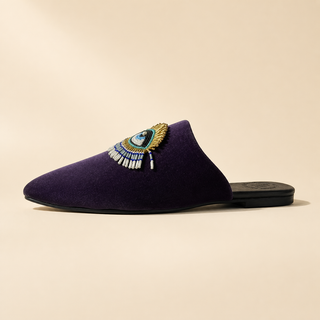
Why it works: Eclipse is midnight navy organza that shifts between blue and near black as the light moves, so in a monochrome outfit it reads as the dark note without looking flat. The beaded evil eye at the toe gives you one point of detail, which is all a black and white outfit needs.
Avoid: a trouser hem that touches the grass. Dew soaks a hem in minutes and the damp line creeps up all day. For the races, have wide leg trousers finish 1 to 2 cm higher at the back than you would wear them to the office.
2. Oaks Day: soft colour and florals
Wear: a pale blue satin or soft floral midi dress, a light jacket for the morning, pearl or gold earrings and Selene.
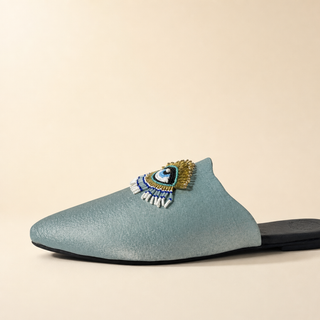
Why it works: Oaks Day favours pastels and fluid fabrics, and a chunky shoe can look heavy against them. Selene is powder blue organza, light enough to sit with satin, and the beading at the toe works like jewellery at the hem.
Avoid: matching every piece to the shoe. Powder blue shoes, a powder blue dress and a powder blue headpiece look like a uniform. Let the dress and the shoe be close, and take the headpiece in cream, gold or a deeper tone.

3. Cup Day: strong colour
Wear: a cobalt, emerald or marigold dress at midi length, a sculptural headpiece, a small clutch and Eclipse.
Why it works: Cup Day is the day for colour, and when the dress is doing that job the shoe should ground it rather than compete. Midnight navy sits under cobalt and emerald without fighting them, and the organza sheen keeps it formal.
Avoid: a second loud colour at your feet. A cobalt dress with a bright red shoe splits the eye in two. One statement colour, one grounded shoe.
4. Stakes Day: relaxed tailoring
Wear: cream wide leg linen trousers, a fitted vest or a relaxed blazer over a camisole, a straw or fabric headpiece and Selene.
Why it works: the last day of the carnival is more relaxed and often warmer, so tailoring in linen looks right. A pointed flat keeps wide trousers from swamping you, and powder blue against cream reads fresh for late spring.
Avoid: assuming relaxed means casual. It is still the races. Keep the shoe dressed and the trousers pressed.
If you want some height: the block heel compromise
Some outfits want a heel, and some women simply feel better in one. If that is you, choose a block heel with a strap behind the heel and plan where you will stand.
Emerald Lustre is a pointed toe slingback with a 3 inch block heel and a memory foam insole. The block gives you a far wider base than a stiletto, and the slingback strap keeps the shoe with your heel on uneven ground. It is also a Cup Day colour in its own right with a cream or black outfit.
Be honest with yourself about the lawn, though. On very soft grass any heel can sink a little. Stay on paths, decking and marquee floors where you can, and step onto the lawn with your weight a little forward. One sizing note: the Lustre styles run small, so order one size up.
For more on why the base of a heel matters, read block heels vs stilettos.
Six race day shoe mistakes and their fixes
- Wearing new shoes for the first time on the day. Race day is the worst place to discover a rub. Fix: two evenings at home in them the week before.
- Sizing up a mule for a long day. A loose mule slips on grass and your toes grip for hours. Fix: your true size, and the ten step carpet test.
- Relying on heel stoppers. They fill with mud and come off in the grass. Fix: a shoe that does not need one.
- Packing folding flats as the plan. Changing at 3pm means the second half of your photos show a different, weaker outfit. Fix: start in the flat you would be happy to finish in.
- Hems that touch the ground. Dew wicks up long trousers and maxi skirts. Fix: wide legs 1 to 2 cm higher than usual, or a midi.
- Ignoring the forecast. Organza prefers a dry day. Fix: if heavy rain is forecast, choose a shoe you do not mind getting wet, and keep your good pair for a dry race day.
The night before checklist
Screenshot this and run through it while you lay out your outfit.
- Have you read the dress code for your enclosure?
- Has it rained in the last two days? If yes, flats over heels.
- Have the shoes had at least two wears at home?
- Is there about 1 cm of room past your longest toe?
- For mules: do they stay on for ten steps without your toes gripping?
- Does your hem clear the ground by 1 to 2 cm at the back?
- Are you wearing the shoes you will leave in? No backup pair required.
Stilettos vs folding flats vs statement flats
| Race day need | Stilettos | Folding flats | Statement flats |
|---|---|---|---|
| Soft lawn | A tip about 1 cm across sinks into damp grass | Stays on top, but thin soles let the damp through | A flat sole spreads your weight and stays on top |
| Six hours standing | Weight pushed onto the balls of the feet all day | Very little between you and the ground | Weight spread along the whole foot |
| Reads formal | Yes, until the heel is muddy | No, it looks like a backup | Yes, through texture, beading and a pointed toe |
| Leaving at the end | Often carried, walking barefoot | Heels in the bag, outfit changed | Same shoes you arrived in |
Frequently asked questions
Can you wear flats to the races in the members' area?
Generally yes. Members' dress codes ask for formal, neat footwear, and they usually rule out thongs, sneakers and casual slides rather than flats as such. A pointed flat in a dressed finish sits comfortably within that. Each club writes its own rules, though, and they can differ between enclosures and days, so read the dress code for your area on the club's website before you go.
Will mules slip off on grass?
Not if they fit. A mule stays on because the vamp holds the top of your foot, so the size has to be right: your true size, with no more than about 0.5 cm of heel over the back edge. Test them on carpet for ten steps. On the lawn, take slightly shorter steps than you would on a path. If your toes grip to keep the mule on, the pair is too big.
What should I do if my organza flats get damp?
Blot, do not rub. Press a soft dry cloth against the damp area, then let the shoes dry naturally at room temperature, away from a heater or direct sun, with a little tissue inside to hold their shape. Once dry, brush away any lawn dust gently. Avoid rubbing the beaded detail. If heavy rain is forecast, choose a different pair for the day.
Do pointed flats look right with a midi dress and a headpiece?
Yes. A pointed toe extends the line of the leg, so a midi that ends between the knee and mid calf still looks long and balanced. The key is proportion: a larger headpiece pairs well with a shoe that has its own detail at the toe, because it gives the eye something at both ends of the outfit. A plain round toe flat is what makes a race day look underdressed.
What colour flats work for Derby Day?
Black, white or a very dark tone that reads as black. Midnight navy works because it moves between blue and near black as the light changes, and a small detail like beading keeps it from looking severe. If your outfit is strictly black and white, keep the shoe to one of the two and let the headpiece carry any detail. Colour is better saved for Cup Day.
Our race day flats: Selene and Eclipse
We designed Selene and Eclipse as flats that look like an occasion. Both are pointed toe mules in organza with a beaded evil eye at the toe and a soft fabric inner lining, so nothing rubs. Both are true to size. Designed in Australia.

Powder blue organza with a beaded evil eye at the pointed toe. Soft enough for Oaks Day satin, fresh enough for Stakes Day linen.

Midnight navy organza that shifts between blue and near black as the light moves, with a beaded evil eye at the toe. The dark note for Derby Day, the grounding shoe for Cup Day colour.
More from the Style Guide: how mules should fit, flats comfortable enough to wear all day and block heels vs stilettos. Or explore the flats collection.