

Comfortable flats balance cushioning, support, space, security, softness, flex and grip. The shape alone does not make a shoe comfortable. A flat can feel easy for ten minutes yet become tiring after two hours if the sole is paper thin, the heel slips or the toe box presses. The right pair should hold your foot without making it work to keep the shoe on, allow your toes to sit naturally and soften each step without feeling unstable.
Wearing flats to a ceremony? See our civil ceremony wedding shoes guide with statement flats.
That matters whether you need comfortable flats for work, travel, a wedding or a day spent walking. It matters even more when shopping online, where appearance is obvious but construction and fit need a closer read. This guide explains why flats hurt, the seven features worth checking, how to assess fit at home and how to find stylish comfortable flats that still look like you.
In this article
- Why can flats hurt?
- Seven features that make flats comfortable
- How should comfortable flats fit?
- Choosing flats for walking, work, travel and weddings
- Comparing ballet flats, Mary Janes, loafers, pointed flats and mules
- How to choose the right flat shoes
- How to make flats more comfortable
- Three real days in flats
- Five mistakes that make flats hurt
- How to find flats that do not rub
- Online buying checklist
- How to style comfortable flats
- Frequently asked questions
Why can flats hurt when they look so simple?
A flat heel does not guarantee an easy shoe. Discomfort usually comes from the way a particular pair fits and moves. A very thin sole can leave little between your foot and hard pavement. A loose heel can slide and create friction. A shallow toe box can press the top or sides of the toes. A rigid upper can repeatedly meet the same part of the foot. A shoe that bends everywhere may also feel less stable than one that flexes mainly where the forefoot bends.
There is also a difference between softness and support. A plush insole can feel immediately pleasant, but cushioning alone does not determine whether the shoe stays comfortable over distance. Fit, sole structure and secure hold still matter. Conversely, a firm shoe is not automatically supportive if its shape does not match your foot. Think of comfort as a system: fit, sole and hold have to work together.
Pain that continues, changes your gait or appears in every pair deserves individual advice from a qualified health professional. For everyday shoe shopping, the useful question is simpler: does this flat give your foot enough space, cushioning and stability for the way you plan to wear it?
Seven features that make flats comfortable
| Feature | What to check |
|---|---|
| 1. Cushioning | A footbed that softens impact without making the foot wobble |
| 2. Support | A stable base and a shape that follows the foot rather than collapsing under it |
| 3. Toe room | Enough width and depth for toes to lie flat and move |
| 4. Secure hold | A heel counter, vamp or strap that limits sliding |
| 5. Soft contact points | Smooth lining and edges where the shoe meets skin |
| 6. Useful flex | A sole that bends at the forefoot but does not twist without resistance |
| 7. Grip | An outsole suited to the surfaces and weather you expect |
Cushioning versus arch support
Cushioning absorbs and spreads some of the pressure you feel underfoot. Arch support describes the contour and structure beneath the midfoot. They are related, but they are not interchangeable. A soft, flat footbed can cushion without offering much contour. A shaped footbed can feel supportive without being especially plush. The best balance depends on your foot, the distance and the surface.
For short daily wear, responsive cushioning and a stable sole may be enough. For long periods on hard ground, look more closely at both structure and underfoot depth. If you use orthotics, confirm that the shoe has enough internal volume and, ideally, a removable insole. Do not assume a larger size will create the right depth. It can simply make the heel loose.
Sole thickness, flex and grip
A sole should protect without feeling clumsy. Press the forefoot and check where it bends. It should move near the ball of the foot rather than fold through the middle. Twist it gently. Some resistance suggests a more stable platform, while a sole that rolls into a tube may feel less protective over a long day. Check the tread too. Smooth soles can look elegant but may be less suitable for wet paving, polished floors or unfamiliar streets. Comfortable flats for walking need traction as well as softness.
How should comfortable flats fit?
A comfortable flat should feel secure at the heel and midfoot, with enough room for every toe to lie flat. Fit both shoes because feet are rarely identical. Try them late in the day, when feet may be slightly fuller, and wear the hosiery or socks you expect to use. Stand before judging. Weight bearing changes both foot length and width.
- Check length. Your longest toe should not touch the front, but excess length should not let the shoe slide.
- Check width. The upper should sit smoothly, without pinching, bulging or leaving deep marks.
- Check toe depth. Wiggle every toe. None should be forced to curl or overlap.
- Check the heel. A small amount of movement may occur in some shapes, but repeated lifting and rubbing is a warning.
- Walk on a clean indoor surface. Turn, stop and take stairs if available. Notice whether your toes grip to keep the shoe on.
- Keep them on for at least ten minutes. Pressure that builds indoors is unlikely to improve during an all day outing.
Should flats be tight or loose?
Neither. A flat should be snug at the heel and across the instep, and relaxed at the toes. In numbers: in a rounded or almond toe, leave about 1cm, roughly a thumb width, between your longest toe and the end of the shoe while standing. In a pointed toe, your toes should end before the shoe starts to narrow, and the empty point beyond them is normal. At the heel, a lift of no more than a few millimetres as you walk is fine. If the heel lifts clear, or you catch yourself gripping with your toes, the pair is too loose.
Uppers soften a little with wear. They will not grow a size, so a pair that pinches in the afternoon will still pinch next month.
Width, volume and foot swelling
Width is only one part of fit. Two feet with the same width can have different volume through the instep and toes. A low cut ballet flat may gape on a shallow foot yet press a fuller foot. A strap can help fine tune hold, provided it does not bite. If your feet become fuller later in the day, fit for that realistic state rather than the first five minutes of the morning.
For comfortable flats for wide feet, prioritise a toe box that matches your forefoot shape. Sizing up is not a universal fix. It adds length as well as width and may create heel slip. Look for measurements, width notes, adjustable straps and exchange terms. If you search for comfortable women's flats Australia, first check whether the sizing is listed in AU, EU or another system before comparing numbers.
Choosing flats for walking, work, travel and weddings
Comfortable flats for walking
Distance raises the standard, so comfortable flats for walking need secure hold, reliable grip and enough sole underfoot for the route. In particular, comfortable flats for all-day walking should suit the pavement, stairs, cobbles, public transport and weather you expect, not just a target step count. A strap or higher vamp can reduce the effort of keeping the shoe attached. Before committing to a full day, wear the pair for a shorter local walk and check for heat, pressure and sliding.
Comfortable flats for work
At work, match the shoe to both the dress code and the day. A pointed or statement flat can sharpen tailoring, while a Mary Jane adds security when you move between meetings. If you stand frequently, focus on cushioning, structure and floor grip. If you sit for long periods, allow for the foot to feel fuller by afternoon. A pair that works with trousers, skirts and dresses earns more wear than one reserved for a single outfit. Our comfortable work shoes guide goes deeper on office fit and function.
Comfortable flats for travel
A useful pair of comfortable flats for travel has several jobs. It needs to handle longer walks, work with a small wardrobe and pack without losing shape. Choose a pair you have already worn, not a brand new shoe for departure day. Check the outsole for the destination and leave room for the way your feet feel after a flight or a warm afternoon. A secure, polished flat can move from transit to dinner without taking a second pair.
Comfortable flats for weddings
The best comfortable flats for weddings should suit the entire venue. Grass, gravel and dance floors favour a stable sole and secure fit. A refined pointed toe, rich texture or bold trim can deliver the occasion feeling without height. Test the shoes with your outfit at home, including the hem length, and wear them before the event. If they are a backup pair, make sure changing heel height will not leave a long dress dragging.
Which type of flat is most comfortable?
| Type | Comfort advantage | Watch for |
|---|---|---|
| Ballet flat | Light and versatile | Thin soles and shallow toe boxes |
| Mary Jane | Strap helps hold the foot | Strap pressure across the instep |
| Loafer | Higher vamp offers security | Instep pressure or heel movement |
| Pointed flat | Polished line without a heel | Toes entering the narrow point |
| Mule | Easy to slip on | Toe gripping and less heel security |
No type wins for every foot. The construction and fit matter more than the label. Pointed toe flats can be comfortable when the functional toe box ends before the decorative point, leaving your toes flat rather than squeezed forward. Loafers can feel secure, but the vamp must suit your instep. Mules may suit shorter, lower movement occasions, while a closed heel or strap is generally easier for a day with substantial walking. See our detailed guides to loafer fit and mule fit.
How to choose the right flat shoes: a decision rule
Choose for the hardest part of your day, not the prettiest outfit.
- If you will walk more than about 10,000 steps, choose a closed heel or a strap: a loafer, a Mary Jane or an ankle strap flat, with a cushioned insole and some tread.
- If you will stand for hours, choose cushioning and a stable sole over the thinnest ballet flat.
- If the day is mostly sitting, then dinner, a mule or a pointed flat is fine; secure hold matters less when you are not walking far.
- If it is 30 degrees or more, choose an open sandal with straps you can adjust, because feet swell in the heat.
- If you have wide feet, judge the toe box shape first and the style second.
Are ankle strap flats more comfortable than regular ballet flats?
For all day wear, usually yes. A ballet flat stays on only because the shoe grips the edges of your foot, so a slightly loose pair slips at the heel and your toes work to keep it on. An ankle strap takes over that job. The strap should sit above the ankle bone and let a finger slide under it; a strap that crosses the bone rubs by lunchtime.
Loafers or flats for daily wear?
A loafer is a flat with more shoe around the foot. The higher vamp covers the instep and holds the foot back into the heel, so it usually feels more secure over a long walking day than a low cut ballet flat. The trade off: it is warmer on a hot day, and a high instep needs a vamp that does not press. For daily wear with a lot of walking, choose the loafer. For warm days with less distance, a ballet flat or mule is lighter.
How to make flats more comfortable
If a pair is close but not quite right, these fixes help. None of them rescues a pair that is the wrong size.
- Heel slip: a self adhesive heel grip inside the back of the shoe takes up a few millimetres and stops the rub.
- Rubbing on bare skin: a no show liner, or a blister patch on the known spot before you leave, not after it hurts.
- Thin sole: a slim cushioned insert can help if there is room; if it lifts your heel out of the shoe, take it out.
- Stiff edges: wear the pair at home for 20 to 30 minutes at a time over a week, so the upper softens where it flexes.
Three real days in flats
Here is the advice above applied to real days, with what to wear, why it works and one thing to avoid.
1. A walking weekend: markets, a gallery and dinner
Wear: straight leg jeans ending just above the ankle, a cream knit, a trench, and Serpentine in brown velvet.
Why it works: a loafer holds your foot at the heel and instep, so your toes are not gripping for 15,000 steps. Serpentine has a memory foam insole and a velvet upper that carries from a market in the morning to a dinner table at night.
Avoid: a backless mule for a day like this. It looks right and it will leave you gripping by mid afternoon.

2. A spring wedding with a long reception
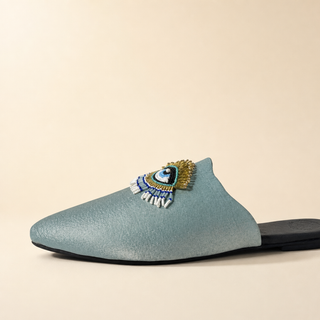
Wear: a pale blue satin slip dress, a light wrap for the evening, and Selene in powder blue organza.
Why it works: a wedding is mostly standing and mingling, not walking kilometres, which is where a flat mule does well. The beaded evil eye at the toe gives the occasion that height usually provides. Try it with the dress at home: a flat needs the hem about 1 to 2cm off the floor so it does not drag.
Avoid: assuming a flat means any lawn is fine. On soft grass or gravel, shorten your step, land heel first and take the paved path where there is one.

3. A 34 degree summer day in the office
Wear: wide linen trousers, a fitted tee, and Sloane in tan nubuck.
Why it works: feet swell through a hot day, and an open sandal gives them room that a closed shoe does not. Sloane has a memory foam insole and a leather lining, and tan sits with every neutral in a summer wardrobe.
Avoid: a closed velvet loafer on a day like this. Save it for the air conditioned months.
Five mistakes that make flats hurt
- Buying the thinnest sole for a walking day. A paper thin sole feels light in the shop and hard on the footpath by noon. Match sole depth to the distance.
- Fitting in the morning. Feet are fuller by late afternoon, more so in an Australian summer. Try on after 3pm.
- Wearing a new pair for the first time on a big day. Travel days and weddings are the worst place to discover a hot spot. Give them three or four short wears first.
- Treating a mule like a walking shoe. Backless styles are for shorter, lower movement days. For distance, choose a closed heel or strap.
- Ignoring the size note. Read whether a style runs small or true to size. Every Walkie Walkie flat is true to size; order your usual size.
How do you find flats that don't rub?
Rubbing is friction, often made worse by repeated sliding or moisture. The back of the heel, little toe, bunion area and top edge are common contact points. Inspect the lining with your fingers. Feel for raised seams, stiff binding and rough joins. Then watch what happens as you walk. A soft edge cannot fully compensate for a shoe that is slipping every step.
Cleveland Clinic recommends gradually breaking in new shoes and protecting likely friction points. Start with short indoor wears, then a brief outing, then a longer day. Stop if a hot spot develops. A blister plaster can protect a known area, but it should not become the permanent solution to the wrong size or shape.

Online checklist for comfortable flats Australia shoppers
When buying online, a comfort claim is only as good as the detail behind it. Product photography should show the toe shape, heel, sole and inside where possible. Read the materials and construction rather than relying on words such as cushioned or supportive.
- Confirm the sizing system and compare it with a pair you already own.
- Measure both feet while standing and use the larger foot.
- Read notes on width, toe shape and whether the style runs small or large.
- Check upper, lining, insole and outsole materials separately. For flats that don't rub on bare feet, look for a leather or soft fabric lining and smooth, turned edges at the heel.
- Look for an adjustable strap if heel hold is often difficult.
- Check whether the insole is removable if you wear an orthotic.
- Read the returns and size exchange terms before wearing the shoes outside.
- Keep packaging and test on a clean indoor surface until the fit is settled.
Australian seasons and distances vary widely, so choose for your actual routine. A pair for air conditioned office days faces a different test from humid travel, winter commuting or an outdoor celebration. The best comfortable flats Australia can offer are the ones whose materials, sole and fit suit the conditions you will meet.
How to style comfortable flats without playing it safe
Comfort does not require a quiet shoe. A bold flat can do the visual work often assigned to a heel. With straight leg denim, show a little ankle or keep the hem above the upper so the shoe reads clearly. With wide trousers, choose enough toe presence to remain visible. With tailoring, a pointed shape adds a clean line. With a simple dress, texture, contrast trim or print creates the focal point.
Balance is more useful than matching. A leopard flat can act as a neutral against black, cream, denim and khaki. A white flat with a red detail can lift navy tailoring or a tonal outfit. Keep one strong idea and let it lead. Stylish comfortable flats should extend what you can wear, not sit in the box waiting for the one perfect occasion.
Frequently asked questions
Can flats really be comfortable for all day walking?
They can, if the fit, sole and route are compatible. Prioritise secure hold, toe room, cushioning, useful forefoot flex and grip. Test the pair over a shorter walk before relying on it for a full day. For real distance, a loafer, Mary Jane or strap flat will usually outlast a low cut ballet flat or mule, because the shoe holds your foot instead of your toes doing it.
Are memory foam flats supportive?
Memory foam provides cushioning, but support also depends on the footbed contour, sole stability and fit. Judge the complete construction rather than one material. In our range, Serpentine, Venome, Dakota and Sloane have a memory foam insole. Selene and Eclipse have a soft fabric lining instead, so we suggest them for standing and mingling rather than long walks.
Why do flats rub at the back of the heel?
The common causes are heel slip, a stiff edge, a raised seam or a mismatch between the heel shape and your foot. Check the size and width first. A soft lining helps, but persistent sliding usually needs a better fit.
Should flats be tight at first?
No. They can feel secure, but toes should not be pinched and edges should not create sharp pressure. Materials may soften with wear, yet a shoe should not depend on painful stretching to become usable. Aim for about 1cm past your longest toe in a rounded toe and no more than a few millimetres of heel lift.
How much room should there be in pointed toe flats?
Your toes should lie flat and avoid the narrowing point. Some empty space beyond the toes is normal because the point creates the silhouette. The heel still needs to hold securely. Stand up and press the top of the shoe: you should feel your toes end before the point begins to narrow.
What is the best flat shape for wide feet?
Choose a toe box that follows your forefoot and has enough depth as well as width. A rounded or almond shape may be easier, but a well designed point can work when the narrowing begins beyond the toes.
How do I break in new flats safely?
Begin with short indoor wears, then a brief outing. Increase time only if there are no hot spots. Do not soak, heat or aggressively stretch a shoe unless the maker specifically recommends it, as that can damage materials or alter the fit.
Can I put orthotics in flats?
Sometimes. Look for a removable insole, adequate depth and a secure heel. Take the orthotic when fitting and confirm that it does not lift your heel out of the shoe.
Comfortable flats, designed in Australia
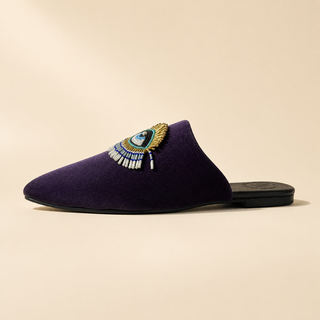
Selene and Eclipse are pointed-toe flat mules, designed in Australia. Both have a soft fabric inner lining that sits gently against the foot, and an organza upper that looks as considered at a wedding all day as it does at dinner. Selene is powder blue organza with a beaded evil eye at the toe. Eclipse is midnight navy with the same detail. As backless mules, they suit days with more standing and mingling than walking. Both are true to size.
For a long walking day, choose a closed heel: our Serpentine and Venome velvet loafers ($259) each have a memory foam insole and a soft fabric lining. For summer, the Dakota and Sloane nubuck sandals ($279) pair a memory foam insole with a leather lining.

Selene
Powder blue embroidered organza pointed-toe flat mule with gold, blue and white hand-beaded evil eye detail and a soft fabric inner lining.
$199 Discover Selene →

Eclipse
Midnight navy embroidered organza pointed-toe flat mule with hand-beaded evil eye embroidery and a soft fabric inner lining.
$199 Discover Eclipse →
Flats with presence
Explore pointed-toe flat mules, velvet loafers and nubuck sandals, designed in Australia.
Explore The Flats Collection →More from the Style Guide: read our guide to choosing women's shoes, comfortable flat sandals and how to style women's loafers. For a broader expert perspective, see NBC News on flats and arch support.