

A beautiful heel should not make you negotiate with your feet by lunch. If you are choosing between block heels and stilettos, the more comfortable option for long wear is usually the block heel. A block heel gives you a wider base, better balance and a steadier stride. A stiletto gives you a sharper, more delicate line, but it asks more from your ankle, your forefoot and your patience.
To feel the difference yourself, browse our block heels for women, every pair built on a memory foam insole.
Planning a day on grass or gravel? Read our spring racing shoes without heels comfort guide.
That does not mean stilettos are wrong. It means they have a different job. Wear them when the moment is short and the look is the point. Choose block heels when you want height, polish and the ability to move through the day without thinking about your shoes.
In this article
Are block heels more comfortable than stilettos?
Yes, block heels are significantly more comfortable than stilettos because the wider base distributes your body weight across a broader surface area, reducing pressure on the ball of the foot and providing greater ankle stability.
Explore Cognac Lustre Block Heel →- The short answer
- What is a block heel?
- Block heels vs stilettos at a glance
- Why block heels feel more comfortable
- When stilettos still make sense
- The best mid heels for everyday wear
- Platforms vs stilettos: comfort and height
- What to check before buying heels
- Three days, which heel for each
- Five heel mistakes and the fixes
- The decision rule
- Comfortable block heels, designed in Australia
- FAQ
Are block heels more comfortable than stilettos?
Block heels are usually more comfortable than stilettos because the wider heel base gives more stability and spreads pressure more evenly. Stilettos place your balance on a narrow point, so your ankle and forefoot work harder. For all day wear, work events and walking, a lower to mid height block heel is the more forgiving choice.
What is a block heel?
A block heel is a heel with a solid, square or rectangular cross section, usually close to as wide at the ground as it is where it meets the shoe. Look at it from behind: if you could fit a thumb flat on the bottom of the heel, it is a block. A stiletto is the opposite, a long, slim heel that tapers to a tip about 1 cm across or less. Between the two sit column heels, flared heels and kitten heels, which vary the width and the height.
That difference in the base is the whole story of comfort. A block heel puts several square centimetres of heel on the ground, so your weight spreads out and your ankle has far less balancing to do. A stiletto puts your weight on a point about the size of a fingertip.
Block heels vs stilettos at a glance
The difference goes beyond the look. The heel shape changes how the shoe feels under your body.
| Feature | Block heel | Stiletto |
|---|---|---|
| Comfort | Better for longer wear | Better for shorter occasions |
| Stability | Wide base, steadier step | Narrow point, more balancing |
| Pressure | More forgiving across the foot | More pressure through the forefoot |
| Best for | Work, events, walking, long lunches, weddings | Short dinners, formal looks, photographs |
| Look | Polished, modern, grounded | Sharp, delicate, dramatic |
Why block heels feel more comfortable
A block heel gives the ground more shoe to meet. You feel it on the first step. The heel lands with more surface area, so your weight is less concentrated and your step feels more secure. Brindabella Podiatry gives the same practical advice for high heels: a wider heel gives more surface area on the ground, lowers pressure through the heel and increases stability.
The Australian Podiatry Association also notes that high heels increase pressure on the ball of the foot, while padded soles help absorb shock and reduce pressure. This is where design matters. A comfortable heel is more than a lower heel. It is the combination of a stable base, cushioning underfoot, a secure fit and a shape that does not force your toes to do all the holding.
Research reviews on high heel comfort point to the same three levers: heel height, heel base size and sole insert. In plain English, that means the height matters, the width of the heel matters, and what sits under the ball of your foot matters. A block heel with a cushioned insole gets two of the three right before you even choose the height.

When stilettos still make sense
A stiletto has its place. It creates a finer line through the leg and can make a formal outfit feel instantly sharper. If you are mostly sitting, arriving by car or wearing them for a short window, the tradeoff can be worth it.
The mistake is asking a stiletto to do the job of a daily heel. If the day includes standing, walking, travel, stairs, grass, uneven pavement or hours between outfit changes, a block heel gives you more freedom. Not less elegance. More freedom.
How to make a stiletto more comfortable
- Keep the height honest. 7.5 cm or lower feels very different from 10 cm. Every extra centimetre adds load to the ball of your foot.
- Add cushioning under the ball of the foot. A thin gel or foam forefoot pad takes the edge off the pressure point where stiletto fatigue starts.
- Choose a strap. An ankle strap, slingback, or pair of Mary Janes holds the foot so your toes are not gripping on top of the balancing.
- Plan the surfaces. Stilettos are for hard, level floors. Grass, gravel, cobbles and floorboards with gaps are block heel territory.
What are the best mid heel shoes for everyday wear, and how do they compare to stilettos?
For everyday wear, the best mid heel is one between about 5 and 8 cm with a wide base, cushioning under the ball of the foot and something that holds the foot in place. Here is how the common mid heel styles compare with a stiletto of the same height.
| Mid heel style | Typical height | Stability | Everyday verdict |
|---|---|---|---|
| Block heel slingback or pump | 5 to 8 cm | High, wide base under the heel | The best all rounder for work, events and walking |
| Kitten heel | 3 to 5 cm | Moderate, the heel is slim but short | Easy for long days; less height |
| Flared or column heel | 5 to 8 cm | Good, though a flare narrows at the ground | A softer look with most of the block benefit |
| Wedge | 5 to 8 cm | Very high, the sole meets the ground along its length | Comfortable, reads more casual |
| Stiletto | 7 cm and up | Low, weight sits on a narrow point | Best for short, mostly seated occasions |
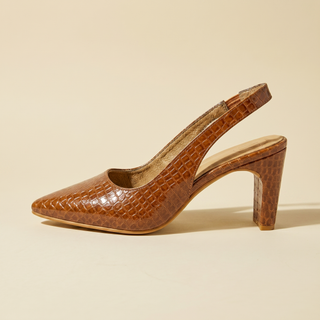
The mid height block heel wins for everyday wear because it gives you the posture and the look of a heel while keeping the ankle out of the balancing act. Our Lustre heels sit here, with a 3 inch (about 7.5 cm) block heel, a pointed toe and a memory foam insole.
How do platforms compare to stilettos for comfort and height?
A platform adds thickness under the front of the foot as well as the heel. What your foot feels is the slope between the two, heel height minus platform height. A 10 cm stiletto with no platform puts you on a 10 cm slope. A 12 cm heel on a 4 cm platform gives you more height from the floor on only an 8 cm slope. That is why a nude platform can look taller than a nude stiletto and still feel easier.
The trade off is weight and feel. A thick platform is heavier and stiffer, so you lose some of the ground contact that helps on stairs and uneven ground. For the most comfortable height, a platform with a block heel beats a platform stiletto every time. Choose nude in the same shade as your skin, or a touch lighter, if the goal is leg length. The effect comes from the colour, not the heel shape, so it works on a block heel too.
What to check before buying heels
The most comfortable heel is not chosen by heel type alone. Before you buy, check these five things.
- Heel base. Wider is steadier. If you want long wear, choose a block, column or shaped heel with enough surface area to support your stride.
- Heel height. A mid height heel around 5cm to 8cm is more realistic for long wear than a very high heel. Height is not the enemy. Excessive pitch is.
- Insole cushioning. Look for proper cushioning under the ball of the foot. This is where most heel fatigue starts.
- Foot hold. A slingback, strap or well shaped upper should hold your foot so your toes are not gripping with every step.
- Size guidance. Read the fit note. If a style runs small, size up. A beautiful shoe in the wrong size is still the wrong shoe.
Three days, which heel for each
1. A full office day with a presentation and a commute
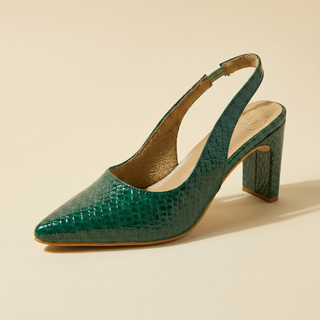
Choose: a block heel around 7.5 cm. Wear: black tailored trousers that skim the top of the foot, a crisp shirt and Emerald Lustre. Why: you will stand at the front of the room, walk between meetings and take the stairs, and a block heel handles all of it without a second pair in your bag. Avoid: planning to commute in flats and change into stilettos at the desk. By Wednesday, most of us skip the change.
2. A spring race day or a winery wedding on the lawn
Choose: a block heel, never a stiletto. Wear: a midi dress in a light fabric and Cognac Lustre, a warm neutral that sits with almost any colour. Why: a stiletto sinks straight into turf and gets caught between pavers and in gravel. A block heel stays on top. Spring race days and winery weddings usually mean hours on grass. Avoid: a brand new pair on the day. Wear them for an evening at home first.
3. A formal dinner, arriving by car
Choose: the stiletto, if you love it. Wear: a column dress or sharp tailoring and your finest heel. Why: two or three hours, mostly seated, on a level floor, is the window where a stiletto earns its place. Avoid: keeping them on for the walk to the after party. Know the moment the job changes.

Five heel mistakes, and the fixes
- Choosing heel type by the outfit, not the day. Fix: count the hours standing and the surfaces first, then pick the heel, then the outfit.
- Going higher to look taller. Fix: use a platform or a nude shade for height instead of a steeper slope.
- Assuming any block heel is comfortable. Fix: a 10 cm block heel with no cushioning is still a hard shoe. Check height, insole and hold as well as the heel base.
- Ignoring the size note. Fix: heels that run small push your toes into the front, which adds to forefoot pressure. The Lustre heels run small, so order one size up.
- Testing on carpet. Fix: walk on a hard floor and take a set of stairs before deciding. Carpet hides wobble.
The decision rule
Screenshot this for the next time you stand in front of the wardrobe.
- More than two hours on your feet: block heel, 7.5 cm or lower.
- Grass, gravel, cobbles or stairs: block heel, whatever the dress code.
- Work day that ends at dinner: block heel slingback with a pointed toe, so it reads sharp at both ends of the day.
- Under three hours, mostly seated, level floors: a stiletto is fine if you love it.
- You want more height without the ache: a platform with a block heel.
For fit, read our slingback heel fit guide. For the same logic applied to flats, see heels vs flats for work.
Frequently asked questions
Are block heels easier to walk in than stilettos?
Yes. Block heels are usually easier to walk in because the wider base gives your foot more stability. A stiletto can feel elegant, but the narrow heel asks for more balance with every step.
Are block heels comfortable for walking?
Block heels are one of the better heel styles for walking because the wider base gives each step more support. For real comfort, look for a moderate height, cushioning under the ball of the foot, and a secure shape that stops your foot sliding forward.
Are block heels appropriate for work?
Yes. Block heels work well for office dressing because they give polish without the balancing act of a stiletto. A pointed-toe block heel feels sharp with tailoring, and the steadier base makes it easier to move from desk to meeting to dinner.
Should you choose a block heel or stiletto for a wedding?
Block heels are one of the best heel choices for weddings because they handle standing, walking and uneven surfaces better than stilettos. If the day includes grass, stairs or hours on your feet, the block heel is the practical choice that still looks dressed.
Can stilettos ever be comfortable?
Yes, for the right window of time. A well fitted stiletto with cushioning can work beautifully for short occasions. For full days, long events or regular wear, a block heel is usually more forgiving.
What heel height is best for comfort?
For many women, a mid height heel is the easiest to wear. The exact number depends on your foot, but the winning combination is usually moderate height, a wider heel base, cushioning and a secure fit.
Should I size up in block heels?
Only if the brand says the style runs small, or if your foot is between sizes and the toe shape needs a little more room. For the Walkie Walkie Lustre heels, order one size up for the right fit.
Comfortable block heels, designed in Australia
This is why the Walkie Walkie Lustre heels are built as block heel slingbacks. They give you three inches of height, a memory foam insole, a soft fabric inner lining and a pointed toe silhouette that still feels dressed. The base is steady. The line is sharp. The comfort is not an afterthought.

A warm neutral heel with three inches of height, a memory foam insole and a soft fabric inner lining. Confident, photogenic and built to stay on all day.

The same memory foam block heel comfort in a deep emerald that makes the whole outfit land. Cushioned underfoot, attention everywhere else.
Height without the negotiation
The Lustre heels bring the sharp line of a pointed slingback together with a steadier block heel and memory foam comfort.
Explore Emerald Lustre Block Heel →More from the Style Guide: our guide to comfortable heels for all day wear and our slingback heel fit guide. Sources: Australian Podiatry Association footwear advice, Brindabella Podiatry high heel advice, and a high heel design review on PMC.