

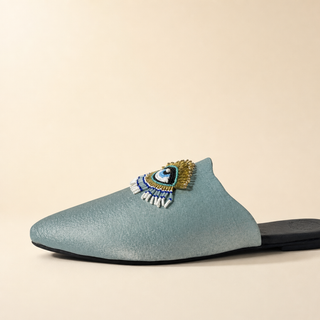
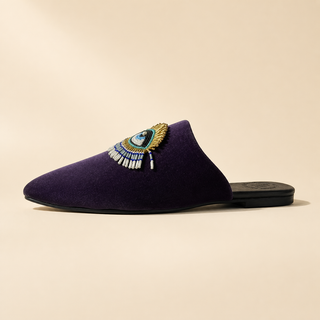
A mule should hold your foot with no strap and no fuss. The fit is right when your longest toe sits just behind the front edge, the shoe grips across the top of your foot rather than at the heel, and there is only a small gap behind your heel when you stand. If your heel lifts more than about a centimetre as you walk, or your toes slide forward and spill over the front, the pair is not fitting the way a mule should. Here are the seven checks that separate a mule you forget you are wearing from one you fight with all night.
Still choosing a pair? Browse our women's flats and mules to see these fit checks on a pointed organza mule with a soft inner lining.
In this article
Explore Walkie Walkie Pointed Mules & Flats
Pointed organza mules with a soft fabric inner lining that sits against the foot so nothing rubs or bites. Discover Eclipse and Selene in our complete collection.
Explore Selene & Eclipse Mules →- The seven checks at a glance
- Where your toes should sit
- The gap behind your heel
- Why mules slip off
- Vamp and width
- Size up or down
- How tall should mules be
- Breaking in a new pair
- How to keep mules on your feet
- Are mules comfortable to walk in
- Three days in mules, worked through
- Five fit mistakes and the fixes
- The two minute mule fit checklist
- FAQ
How should a mule fit? The seven checks at a glance
A mule has no back and no strap, so the fit is doing quiet work that a closed shoe does for you. Length holds the shoe on. The top of the foot keeps it there. Get those two right and the rest follows. Run through this table next time you try a pair.
| Checkpoint | A good fit feels like | Warning sign |
|---|---|---|
| Toe position | Longest toe 5mm to 10mm behind the front edge | Toes touch or hang over the front |
| Heel gap | Heel near the back edge, a gap under 1cm | Heel hangs off, or sits far forward |
| Vamp grip | Snug across the top of the foot, no pinch | Gapes open, or digs a red line |
| Width | Foot sits inside the sole edges | Foot spills over the sole sides |
| Walking hold | Heel lifts only slightly, shoe stays on | You curl your toes to keep it on |
| Underfoot | Cushioned, no pressure point at the ball | Hard, flat, sore after an hour |
| Sizing | True to your usual size, length controls slip | Sized up for room, now it slides |
Where should your toes sit at the front?
Your longest toe, which is not always the big toe, should sit a small gap behind the front edge of the shoe. Around 5mm to 10mm is right. You want a sliver of room, not a stretch of empty shoe. In a pointed-toe mule the point extends past your toes by design, so judge the gap from where the toe box actually ends, not from the tip of the point. Toes that press into the front will ache within the hour. Toes that hang over the edge mean the shoe is too short and will rub on every step.
How big should the gap be behind your heel?
This is the question every mule comes down to. Standing still, your heel should sit close to the back edge of the sole with a gap under a centimetre. A little space is normal and even helpful, because it stops the back edge cutting into your heel as you move. What you do not want is your heel hanging off the back, or sitting so far forward that your toes crowd the front. Both mean the length is wrong. The heel will float on a long shoe and clip the ground on a short one.

Why do mules slip off when you walk?
A backless shoe changes how you walk. With no heel counter to hold you, your foot relies on the vamp, the panel across the top, to stay put, and many people quietly grip with their toes to keep the shoe on. Done all night, that grip is what leaves your feet tired. So a mule that slips is almost never a walking problem. It is a fit problem, and it is usually one of three things: the shoe is too long, the vamp is too loose, or the width is too wide and your foot slides around inside it.
Fix the length first, because length controls slip more than anything else. A snug vamp does the rest, holding the top of your foot so your heel rises and falls with the shoe instead of lifting away from it. Studies on flat, backless shoes like flip-flops have found they can shorten your natural stride, because you instinctively shuffle to keep the shoe on, which is exactly why the fix is fit, not effort. You can read more on how flat, backless shoes affect your stride.
How should the vamp and width feel across your foot?
The vamp should sit snug across the widest part of your foot, firm enough to hold but never pinching or cutting a red line into your skin. If it gapes open when you lift your foot, the shoe will slide. If it bites, the shoe is too tight or too narrow for you. Width matters just as much. Your foot should sit inside the edges of the sole, not spill over the sides, which both looks off and lets your foot roll as you walk. A soft fabric lining helps here, sitting gently against the skin so the vamp can be secure without rubbing.
Should you size up or down in mules?
Take your usual size. The instinct with an open shoe is to size up for breathing room, and that is the exact move that makes a mule slip, because the extra length leaves your heel floating off the back. If you sit between two sizes, the smaller one almost always holds better in a backless style, since length is what keeps the shoe on. Width is the only reason to ever consider going up, and even then a wider fit in your true length beats a longer shoe. Eclipse and Selene carry no size-up note, so start with the size you normally wear, and always check the note on each product page before you buy.
Size note: not every Walkie Walkie style fits the same. Our Lustre slingbacks, Cognac and Emerald, run small, so order one size up. Always check the note on each product page so you order the right size for that style.
How tall should mules be?
Lower than most women expect. A mule has nothing behind the heel, so every extra centimetre of height tips more of your weight onto the front of your foot and asks the vamp to do more of the holding. For a mule you plan to walk in, flat to about 5 cm is the comfortable range. From 5 to 7.5 cm a mule works for an evening if the vamp is high and firm. Above about 8 cm, your heel starts lifting out of the shoe with every step, and most women end up shuffling.
| Heel height | What it is | Best for | How it walks |
|---|---|---|---|
| Flat, under 2 cm | A flat mule or slide | Full days, desk to dinner, travel, markets | Closest to your normal stride |
| 3 to 5 cm | A kitten heel mule | Office days, lunches, dinners | Easy, as long as the vamp is snug |
| 5 to 7.5 cm | A mid heel mule, ideally a block | Evenings and events where you will sit | Wearable with shorter steps |
| Over 8 cm | A high mule heel, often a stiletto | Short, mostly seated occasions | Hard work: the heel lifts out on every step |
| Platform mule | Extra sole under the front as well as the heel | Height with a gentler slope | Judge the slope, not the heel figure |
So what are the differences between mules, mule heels, and platform mules? A mule is any backless shoe with a covered front, flat or heeled. A mule heel is simply a mule with a raised heel, usually a kitten, a block or a stiletto. A platform mule adds thickness under the front of the foot as well as the heel, so a 9 cm heel on a 3 cm platform feels closer to a 6 cm slope. That slope, heel height minus platform height, is the number your feet actually feel. If you want height in a backless shoe, a block heel is the steadier base, for the same reasons we set out in block heels vs stilettos.
How should mule heels fit?
The seven checks above still apply, with two of them tightened. In a heeled mule your foot is angled downhill, so it wants to slide forward. The vamp has to stop that slide, which means it should sit higher and firmer across your foot than it would on a flat. And the heel gap should close up: your heel should rest right at the back edge, because any spare space turns into forward slide once the shoe is tilted. Eclipse and Selene are flat pointed mules, so they sit at the easiest end of the table.
How long before a new mule feels right?
A mule with a soft fabric lining needs almost no breaking in. Give it a wear or two around the house to be sure. If a mule still slips after that, do not wait for it to improve, because length and width do not break in. That is a sizing issue, not a wearing-in one, and the honest answer is the wrong size. A pair that fits is comfortable from the first walk.
How do you keep mules on your feet?
Start with the fit, because no trick rescues a pair that is too long. If the gap is bigger than a fingertip, the size is wrong, and the answer is an exchange, not a fix. Once the length is right, these small adjustments help to keep a mule where it belongs through a long day.
- Add grip under the ball of your foot. A thin, clear forefoot grip pad stops your foot sliding forward toward the point. Forward slide is what pulls your heel away from the back edge, so stopping it at the front holds the back.
- Manage heat and sweat. On a hot Australian summer day, bare feet get damp and slide on any lining. A light dusting of foot powder before you leave, or a no show toe liner, keeps your foot where you put it.
- Fit for your feet at their largest. Feet swell through the day, more so in heat and after standing. Try a new pair in the late afternoon, so the vamp that feels snug at 5pm is not pressing by dinner and not loose by morning.
- Relax your toes and let the vamp hold. If you catch yourself curling your toes to keep the shoe on, stop and walk a few steps flat footed. If the shoe stays, it was habit. If it slides, the vamp is too loose for your foot.
Are mules comfortable to walk in?
Yes, when they are flat or low and they fit. A flat mule with a snug vamp and a soft lining is comfortable for a normal day of walking: the commute, the office, lunch, the walk back to the car. Where mules become hard to walk in is height, distance and ground. Put a high heel, a long walk over cobblestones or a sloping lawn together with a pair half a size too long, and you will feel every step. So when someone asks whether mules are hard to walk in, the shoe is rarely the whole answer. Height and fit usually are.
How to walk in mules
- Take a slightly shorter step. A long stride pulls the heel out of a backless shoe. Shorten it by a few centimetres and your heel lands back on the footbed every time.
- Land heel first and roll through. Put the heel down, roll onto the ball of your foot, then lift. Flicking the foot forward from the ankle is what throws a mule off.
- Lift from the knee. Raising the whole foot keeps the sole level, so the shoe rises with you instead of hanging from your toes.
- Take stairs with your whole foot. Place the full sole on each tread and use the rail on the way down, where a backless heel is most likely to slip off the edge.
- Slow down on slopes in mule heels. Walking downhill pushes your foot toward the point. Short steps and a firm vamp keep your toes where they should be.
Three days in mules, worked through
Fit is half of it. The other half is choosing the right day for a backless shoe and dressing so nothing works against it. Here is how that plays out.
1. A desk day that ends at dinner
Wear: straight leg cream trousers that finish 1 to 2 cm above the floor at the back when you stand, a fine black knit, a small gold earring, and Eclipse in midnight navy organza.
Why it works: an office day is mostly short walks on flat floors, which is exactly what a flat mule does best. The navy reads as a dark neutral at your desk, and the beaded evil eye does the evening work at the table without a change of shoe. Avoid: a full length wide leg trouser that brushes the ground. With no back on the shoe, a long hem slides under your heel and you will step on it all day.
2. A garden engagement lunch or a wedding on the lawn
Wear: a pale blue satin slip dress or navy draped trousers, a light cardigan for when the afternoon cools, and Selene in powder blue organza.
Why it works: a flat sole stays on top of the grass, where a stiletto sinks at every step, and powder blue organza reads occasion, even bridal, without any height at all. Avoid: hot, bare feet on a warm spring afternoon outdoors. That is when a mule starts to slide, so keep a forefoot grip pad in the shoe and a little powder in your bag.
3. A warm Saturday: markets, then a long lunch
Wear: white linen trousers cropped just above the ankle, a striped shirt, a woven bag, and Eclipse.
Why it works: a day with stops, browsing, sitting, walking a few blocks between them, suits a backless shoe that slips on and off easily. The cropped hem keeps the open heel clear. Avoid: planning a full day of city walking in any mule. If your day involves more than an hour of continuous walking, choose a shoe with a strap or a closed back and keep the mules for the lunch.

Five fit mistakes that make mules slip, and the fixes
- Sizing up for breathing room. An open shoe feels like it needs extra space. It does not. The extra length is what leaves your heel floating off the back. Fix: take your usual size, and go down, not up, if you sit between sizes.
- Judging toe room from the tip of the point. In a pointed mule, the point is styling, not space. Fix: press the upper gently to find where the toe box actually ends, and measure your 5mm to 10mm from there.
- Trying them on sitting down, or on carpet. Carpet grips the sole and hides slip. Fix: walk ten steps on a hard floor and watch whether your heel lands back on the footbed each time.
- Choosing the height for the photo, not the walk. A high backless heel looks beautiful standing still. Fix: keep mules over about 8 cm for seated occasions, and choose flat to 5 cm for anything with walking.
- Treating toe gripping as normal. Curled toes all day are what leave your arches aching by evening. Fix: if you cannot relax your toes without the shoe sliding, the vamp or the length is wrong for your foot.
The two minute mule fit checklist
Run through this at home, on a clean hard floor, before you decide a new pair is a keeper.
- Standing, is the gap behind my heel under 1 cm?
- Is my longest toe 5mm to 10mm from where the toe box ends, not the tip of the point?
- When I lift my foot, does the vamp stay closed across the top instead of gaping?
- Walking ten steps, does my heel land back on the footbed without my toes gripping?
- Does my whole foot sit inside the edges of the sole?
- Is the heel height right for how far I will actually walk?
- Have I checked the size note on the product page for this exact style?
If a pair fails the heel gap or the vamp check, do not wear it outside hoping it will settle. Length does not break in. We exchange sizes free within 30 days of delivery, but test in your hallway, not on the street. A pair you keep should fit before it leaves the house.
Frequently asked questions
Should mules be tight or loose?
Neither extreme. A mule should be snug across the vamp and true to length, secure but not pinching. Loose is what makes a mule slip, and tight is what makes the vamp dig in. Aim for held, with a small gap at toe and heel.
Why do my mules slip off at the heel?
Usually the shoe is too long, the vamp is too loose, or the width is too wide. Length is the most common cause. A backless shoe stays on through a close length and a snug vamp, so a half size too big will float at the heel no matter how you walk.
Do mules stretch out over time?
The lining and insole soften and mould slightly to your foot, but the length and the structure do not stretch in any meaningful way. Do not buy a mule that slips and hope it tightens up. Buy the size that holds from the first wear.
Can you walk a lot in flat mules?
Yes, when they fit. A flat mule with a secure vamp and a soft lining lets you walk normally instead of gripping with your toes, which is what tires your feet in a poorly fitted pair. Fit is what makes a flat mule an all-day shoe.
Are pointed-toe mules true to size?
Most are. The point extends past your toes for the look, so it does not change your size. Eclipse and Selene carry no size-up note, so order your usual size. Judge the fit from where the toe box ends, not the tip, and check each product page in case a style says otherwise.
Shop the look
The pieces from this guide, ready to wear.

Eclipse
Midnight navy organza that shifts between blue and near-black, with a beaded evil eye at the toe. Sharp point, soft fabric lining, no rub and no break in.
$199 AUD
Select size (UK)
30-day returns · Free shipping Australia-wide

Selene
Powder blue organza that catches the light, with the same beaded evil eye at the toe. Reads bridal, occasion and everyday, on a soft fabric lining.
$199 AUD
Select size (UK)
30-day returns · Free shipping Australia-wide
Find the mule that stays on
Eclipse and Selene are pointed organza mules built to be worn, not just admired. Soft fabric lining, designed in Australia.
Explore the collection →Free standard shipping on every order Australia-wide.
More on fit from the Style Guide: how should slingback heels fit, how should loafers fit, and the full guide to choosing women's shoes. Ready to shop the style? Explore our Selene and Eclipse mules.