


A beautiful sandal should make the day feel more open, not make you count the steps back to the car. The most comfortable flat sandals combine a secure fit, cushioning underfoot, straps that hold without pinching, a stable sole and upper materials that feel good against bare skin. Flat alone does not guarantee comfort. The details decide whether a sandal becomes the pair you keep reaching for.
Heading to an outdoor wedding? See our winery wedding guest shoes guide.
Use the checks below before you buy. They will tell you how flat sandals should fit, where a pair is likely to rub and whether it suits the kind of day you have planned.
In this article
- What are flat sandals?
- How do I know which women's flat sandals are best for me?
- How should flat sandals fit?
- What key features should you look for in comfortable sandals?
- Sandals and flat feet
- How do you wear flat sandals?
- Three real days in flat sandals
- Do cheaper flat sandals last?
- Five mistakes that make sandals uncomfortable
- Looking after nubuck sandals
- The five minute sandal checklist
- Frequently asked questions
- The sandals to start with
What are flat sandals?
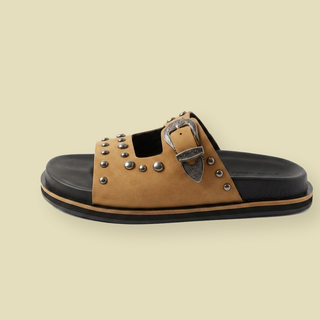
Flat sandals are open shoes with a sole that sits level or close to level, held on by straps rather than a closed upper. The main types are the slide (a strap or two across the front with an open back), the two strap sandal, the ankle strap sandal and the thong. A slide is the easiest to put on, and an ankle strap is the most secure. Our Dakota and Sloane are studded slide sandals with two straps, an engraved silver buckle and a memory foam insole.
How do I know which women's flat sandals are best for me?
Start with the day, then the foot. The best pair is the one that matches how far you will walk, how much hold you need and what you will wear it with. Use this table as a first cut.
| If your day is | Look for | Why |
|---|---|---|
| Errands and short outings | A simple slide with a padded footbed | Quick on and off, low demands |
| Two hours or more on your feet | A cushioned insole and a sole that flexes at the ball of the foot | Hard ground shows up in the arch first |
| Hot days, bare skin | A smooth lining, such as leather | Nothing rough where skin meets shoe |
| Dressing up | A material with presence, such as nubuck, and metal detail | Reads as a dressed sandal, not a beach one |
How should flat sandals fit?
Your heel, toes and the widest part of your foot should sit fully inside the sandal. Nothing should spill over an edge. The foot should feel held without being squeezed, and you should not need to curl your toes or shorten your stride to keep the shoe on.
Use these checks. Your heel should sit inside the back edge of the footbed, with no overhang. Your toes should stop about 5 to 10 mm before the front edge, so nothing slides off as you walk. Slide one finger under each strap, and it should fit with a little resistance. If two fingers fit easily, the strap is too loose.
Try both sandals and walk on a clean indoor surface for a full minute. Feet swell through the day and in the heat, so a fit that feels exact first thing in the morning can feel restrictive by four. Try on late in the afternoon.
How do I choose the right size for women's flat sandals?
Go by the brand's sizing note, then by the checks above. Dakota and Sloane are true to size, so order your usual size. Both come in UK 4 to UK 9. If you sit between sizes, choose the one that lets your heel sit inside the footbed edge, because a sandal has no closed toe or back to catch a shoe that is too big.
What key features should you look for in comfortable sandals?
Five things decide whether a flat sandal is comfortable. Here is what each one should feel like, and the warning sign that it is wrong.
| What to check | What good feels like | Warning sign |
|---|---|---|
| Length and width | Your whole foot rests inside the sole | Toes, heel or sides overhang |
| Straps | Secure without pressure or pinching | Sliding, gapping or visible marks |
| Footbed | Cushioning matches your activity | Hard impact from the first step |
| Sole | Stable, with flex where the foot bends | Flimsy, slippery or completely rigid |
| Upper material | Comfortable against bare skin | Rough edges at movement points |
The footbed
A thin sole can look refined and still feel unforgiving after an hour. Look for cushioning that softens contact with the ground without making the foot unstable. Dakota and Sloane both have a memory foam insole for comfort underfoot. It is one part of the decision, and fit, straps and your own foot still matter.

Dakota pairs a cushioned footbed with blue nubuck leather and an engraved buckle.
The straps
Straps should keep the sandal with you as you walk. Too loose, and the foot slides and your toes grip. Too tight, and pressure builds at the buckle or across the top of the foot. Check every contact point on a short walk, because a strap can feel fine standing still and rub once the foot moves.
The sole
The right sole feels stable under the whole foot and bends where your foot naturally bends. It should not twist without resistance or let you feel every edge in the pavement. Test the traction on a smooth indoor floor before you commit.
The upper
Sandals put the upper directly against skin, so finish matters. Run a finger along the inside edges. Look for hard seams, sharp hardware or rough points where the foot flexes. Nubuck is leather with a softly buffed surface and a matte finish. Dakota is blue nubuck and Sloane is tan, both with a leather lining and silver stud detail.
Sandals and flat feet
If you have flat feet, the Australian Podiatry Association suggests choosing sandal features that match your foot shape and posture. For a flexible flat foot it lists a slight heel pitch, a mildly cushioned footbed, some arch contour and adjustable straps, kept for a leisurely pace of activity.
We are straight about what ours offer. Dakota and Sloane are flat, with a memory foam insole and an engraved buckle. We do not claim arch support. If you have flat feet or foot pain, choose sandals for easy, short days, wear them for an hour at a time to start, and see a podiatrist if the pain does not settle. Here is the Australian Podiatry Association guide to buying the right sandal.
How do you wear flat sandals?
Treat the sandal as the finishing detail and let the hem do the work. A studded nubuck sandal already has character, so keep the rest of the outfit simple.
- Cropped or straight trousers. Finish the hem 2 to 4 cm above the ankle bone so the strap and the foot show.
- Wide leg linen. Let the hem skim the top of the foot, with the back of the hem about 1 to 2 cm off the floor.
- Midi skirts and dresses. A flat sandal is the easy match. A hem between just below the knee and mid calf balances the shoe.
- Denim. Straight or slightly cropped jeans with one clean 3 cm cuff.
- Shorts. Tailored shorts just above the knee suit a dressed sandal. Skip a tired pair of cutoffs.
Tan is a warm neutral beside cream, navy, khaki and prints. Blue sharpens white, grey, denim and tonal looks. Choose the one that adds something without needing a new wardrobe around it.
Three real days in flat sandals
The Saturday market and brunch. You will walk for two hours in the heat, sit for one, and your feet will swell. Wear a white linen dress and Sloane, the tan nubuck slide. Avoid wearing a new pair for the first time on a long walk. Wear them around the house for an hour beforehand.

The smart casual office on a hot day. The dress code allows open shoes and it is 34 degrees. Wear navy tailored trousers cropped above the ankle and Dakota in blue nubuck. Avoid open shoes for any meeting where the dress code says closed toe.
The warm evening out. Dinner outdoors, dressed up but flat. Wear a slip dress or midi skirt with Sloane or Dakota. The studs read as jewellery for the foot. Put sunscreen on the tops of your feet before you leave, because a strap line is hard to hide.
Do cheaper flat sandals last?
Price alone does not tell you how long a sandal will last. Check the strap fixings, seams, sole and care needs, then compare cost per wear using a realistic wear target. A $30 sandal worn 20 times costs $1.50 a wear. A $279 sandal worn 100 times costs $2.79 a wear. That does not make the dearer pair automatically better. It shows the wear target it has to earn. Nubuck develops a patina with wear, and a leather lining feels smoother against bare skin than a plastic one. Check the seams, the strap fixing and whether the sole flexes before you decide.
Five mistakes that make sandals uncomfortable
- Buying by looks alone. Fix: run the five checks above.
- Trying on in the morning. Fix: try on late in the afternoon.
- Sizing for a rested foot. Fix: leave 5 to 10 mm at the toes and keep the heel inside the footbed.
- Long walks in a new pair. Fix: wear them in for an hour at a time, twice.
- Ignoring the day. Fix: use a cushioned, secure pair for long days and a simple one for errands.
Looking after nubuck sandals
Nubuck develops character with wear, but its brushed surface needs the right care. Remove dry surface dust with a clean nubuck or suede brush. Treat marks gently with a product made for nubuck, and test any protector on a hidden area first. Let the sandals dry naturally away from direct heat. Avoid standard shoe polish, which can flatten or darken the nap. For the full routine, read our guide on how to clean nubuck shoes.
The five minute sandal checklist
- Heel inside the back edge of the footbed?
- 5 to 10 mm before the front edge?
- One finger fits under each strap?
- Does the sole flex at the ball of the foot?
- Any rough seam or hardware against skin?
- Can I picture four outfits with them?
Frequently asked questions
Are flat sandals always more comfortable than heels?
No. A completely flat sandal with a hard, thin sole or loose fit can be less comfortable than a well fitted low heel. Judge the whole construction, including cushioning, straps, stability and the activity you have planned.
Should sandals fit tightly at first?
They should feel secure, not tight. Do not rely on painful pressure points disappearing. The straps should hold the foot without digging in, and your toes, heel and sides should remain inside the sole.
Can comfortable flat sandals be worn all day?
That depends on your foot, the fit, the sandal and the day. Cushioned, secure sandals can suit long periods of everyday wear, but walking distance, surfaces and individual support needs matter. Persistent pain is a reason to speak with a podiatrist.
What makes nubuck different from smooth leather?
Nubuck is buffed on the outer surface to create a soft, matte nap. That finish gives it depth and texture, but it also needs a nubuck specific brush and care products rather than standard polish.
What are the best flat slides for women?
The best flat slides have a secure strap, a cushioned insole and a lining that feels smooth against bare skin. Our Dakota and Sloane are slide sandals in nubuck with a memory foam insole and leather lining, both true to size.
Source: Australian Podiatry Association, How to buy the right sandal. For a broader buying framework, read our guide to choosing women's shoes and our guide to finding comfortable flats.
The sandals to start with
Both are designed in Australia, true to size and come in UK 4 to UK 9.

Blue nubuck with silver studs, a memory foam insole and leather lining. An engraved buckle.

Tan nubuck with silver studs, a memory foam insole and leather lining. An engraved buckle.
Or explore the sandals collection, designed in Australia to stay comfortable from the first step to the last.