

Slingback heels should feel secure at the back without digging in, hold your foot without making your toes grip, and leave about a thumb-width of space in front of your longest toe. The strap should keep your heel from lifting too much, the widest part of your foot should meet the widest part of the shoe, and the pointed toe should shape the silhouette rather than crush your toes. If a slingback feels loose at the heel, tight at the toes or unstable underfoot in the shop, it will feel worse later, not better.
Ready to compare? See our block heel slingbacks for women, or the full heels collection.
Looking for a print? See how to style animal print shoes.
The checks below make the fitting decision simpler. They tell you how a slingback should sit at the back, when a pointed toe is still the right fit, and when sizing up is the honest move.
| Fit point | What good feels like | Warning sign |
|---|---|---|
| Back strap | Secure, flat against the heel, no digging | Slipping down or cutting in |
| Toe room | A little space in front of the longest toe | Toes touching, curling or crossing |
| Width | The ball of the foot meets the widest point | Pinching or bulging at the sides |
| Heel hold | Small natural movement, no free lift | Heel popping out each step |
| Underfoot feel | Stable block heel, flex at the toes | Twisting, wobble or forefoot pressure |
1. How tight should the slingback strap feel?
Discover All-Day Block Heel Slingbacks
Featuring a 3-inch block heel, a soft fabric inner lining and a memory foam insole. Both styles run small, so order one size up. Explore Cognac Lustre and Emerald Lustre.
Explore Cognac Lustre Slingback →The strap should sit flat against the back of your heel and feel secure, not sharp. It is there to hold the shoe with you as you walk, not to clamp the foot in place. If it leaves a deep line straight away, it is too tight. If it drops down as you take a few steps, it is too loose.
The Australian Podiatry Association's footwear health check puts fastening in the same category as support. A shoe that is tied, buckled or otherwise secured keeps the foot from jamming into the front. That matters even more in a slingback, because the open back means the strap does part of the holding job a closed heel usually handles on its own.
2. How much toe room should a pointed slingback have?
Pointed toe does not mean cramped toe. You still want about one thumb-width, or roughly 1.5 centimetres, between your longest toe and the front of the shoe, which is the Australian Podiatry Association's rule of thumb for fit. The tip of a pointed shoe often extends beyond the part your toes actually use, so judge the internal space, not the decorative point alone.
If your toes touch the front, overlap, or curl slightly to make the shoe work, the fit is off. That discomfort usually shows up earlier in slingbacks because your foot has less back coverage to keep it in place. The wrong fit makes the foot slide forward and pushes all the pressure into the toes.

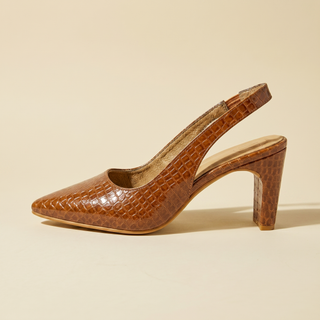
Cognac Lustre keeps the pointed shape sharp, but the fit still has to leave real room in front of the toes.
3. Should your heel slip in the back of slingbacks?
A little surface movement can happen in a slingback because the back is open. Free slipping is different. Your heel should not pop out of the shoe each step, force you to shorten your stride, or make your toes claw for grip. If it does, the strap tension, the size, or the shape is wrong.
This is where people talk themselves into a bad fit because the shoe still looks right standing still. Always test the heel hold while walking. Turn, pause and take a few natural steps. If the heel lags behind your foot, that is not a breaking-in issue. It is a fit issue.
4. Where should the shoe hold and bend?
A good slingback should hold you firmly through the strap and the upper, but bend where your toes bend. The Australian Podiatry Association's footwear health check recommends testing both. Press the back of the footbed to check your heel sits on a firm base, and bend the front to make sure the flex is happening near the toes rather than through the middle of the shoe.
That combination matters because a slingback can feel loose if the back is too soft, even when the size looks right. At the same time, a shoe that twists through the middle or folds under the arch tends to feel unstable once you are on hard floors for more than an hour.
5. What heel shape stays comfortable longer?
For most women, a lower or mid block heel stays wearable longer than a narrow stiletto because it spreads your weight across a wider base. That is especially useful in slingbacks, where the silhouette is already giving you less containment at the back than a closed pump. A stable heel makes the whole shoe easier to trust.
The Australian Podiatry Association's sandal guidance makes a similar point about stability, support and secure straps. In practical terms, that means choosing a slingback whose strap and heel work together, rather than asking a delicate strap to control a shoe built on a difficult base. If you want the broader comfort checklist, our guide to heels comfortable enough to wear all day goes deeper on heel height, cushioning and pain prevention.

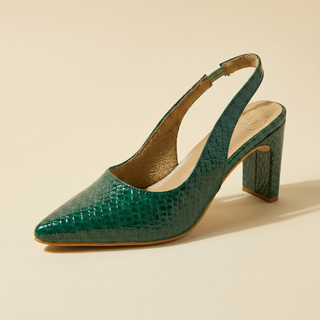
Emerald Lustre pairs a pointed slingback upper with a stable 3-inch block heel, the base doing as much of the comfort work as the strap.
6. When should you size up in slingback heels?
Size up when the length is only just enough, your toes are crowded by the point, or the strap feels like it is compensating for a shoe that is too short. This matters most in pointed slingbacks because a short fit pushes the foot forward and makes the strap feel harsher than it really is.
That is why we say on both Cognac Lustre and Emerald Lustre that the style runs small, and to order one size up. The design itself is precise: pointed toe, 3-inch block heel, memory foam insole, soft fabric lining.
7. How should you test slingback heels before keeping them?
Fit them late in the day, when your feet are slightly fuller from walking and standing. Test both shoes, fit to the larger foot, and wear the hosiery you would actually pair with them. Then walk, stop, turn and stand still for a minute. A good slingback should feel calm, not busy. You should not feel the need to grip with your toes or adjust the strap every few steps.
If you are buying online, compare what you feel against the product facts, not wishful thinking. Does the shoe have a secure slingback, a stable heel base, cushioning underfoot and a real size note if it runs small? For the broader framework across styles, go back to our guide to choosing women's shoes.
Are slingback heels comfortable?
They can be among the most comfortable heels you own, and the reason is the design. A slingback is a shoe with a closed or pointed front and an open back, held on by a strap that runs behind the heel. With no stiff heel counter pressing on the back of your ankle, there is nothing to rub the spot where most court shoes give you blisters. The trade off is that the strap and the front of the shoe have to do all the holding. When they fit, a slingback feels lighter than a closed pump. When they do not, your foot slides forward and your toes take the load.
So which slingback sits comfortably enough for someone on their feet all day? Use this as your decision rule.
| Your day | Choose | Why |
|---|---|---|
| Standing or walking most of the day | A block heel of 5 cm or less, or a flat slingback | Less weight tipped onto the ball of the foot |
| Desk day, then dinner or drinks | A block heel around 7.5 cm (3 inches) | Real height with a wide, stable base |
| A few hours, mostly seated | Any heel you walk in confidently, including a slim one | Short wear forgives a narrower base |
| Grass, cobbles or gravel | A block heel, never a stiletto | A wider base stays on top of uneven ground |
Cognac Lustre and Emerald Lustre sit in the middle row: a 3 inch block heel with a pointed toe, a memory foam insole and a soft fabric inner lining.
What if your slingback strap is too loose, or the shoe is too big?
A loose strap and a shoe that is too big feel similar, and the fix is different, so work out which one you have first. Stand with your weight even and look at the back of your heel. If your heel sits right at the back edge of the footbed and only the strap is slack, the strap is the problem. If there is a gap behind your heel on the footbed itself, the shoe is too long, and no strap adjustment will fix that.
- Strap slips down but the length is right: a thin, clear heel grip stuck on the inside of the strap adds friction and a millimetre or two of tension. If the strap has a buckle, take it in one hole.
- Strap still slips after that: a shoe repairer can shorten a fixed strap. It is a small job, and far better than walking all night with your toes clawing.
- The shoe is too long: a gap behind the heel, or toes that have 2 cm or more of room, means the size is wrong. Exchange it. A padded insert under the ball of the foot can help half a size at most.
- Only one foot slips: most women have one foot slightly smaller. Fit the larger foot, and add a heel grip to the other shoe.
How to walk in slingback heels
Walking well in a slingback is mostly about keeping the foot from sliding forward, which is what loosens the strap in the first place.
- Land heel first, then roll through the ball of the foot. Landing flat or toe first drives the foot toward the point and pulls the strap down.
- Take a slightly shorter stride than in flats. In a 7.5 cm heel, a long stride tips your weight forward. A shorter step keeps it over the heel.
- Stand tall and let your weight sit back. Leaning forward loads the toes. Shoulders back keeps pressure spread across the whole footbed.
- On stairs, place the whole shoe on the tread. Going down with just the ball of the foot on the step is the moment a strap slips.
- Wear them at home for an hour first. Walk on a hard floor, take the stairs and stand still for ten minutes. If the strap needs adjusting every few steps indoors, it will need it outside too.
What are the best materials for comfortable slingback heels?
Comfort in a slingback comes from three layers: the upper, the lining and what sits underfoot. The best materials for comfortable slingback heels, silver and metallic pairs included, follow the same rules.
- The upper: soft leather, suede or a well made vegan leather gives slightly across the toes without losing shape. Very stiff patent or thick synthetic uppers do not give at all, so the toe room has to be right on day one.
- Metallic and silver finishes: the shine is a coating or foil on the surface, so the comfort still depends on the material underneath. Look for a soft base leather or vegan leather, and flex the toe in the shop. If you see the finish crack or crease sharply, the upper is stiff.
- The lining: a soft fabric or leather lining against bare skin is what stops rubbing at the toe and under the strap. A rough or plastic lining feels fine for ten minutes and sore after two hours.
- The strap: a strap with a smooth, soft inner face sits flat. A strap with a raw or hard edge cuts in, however well it is adjusted.
- Underfoot: a cushioned insole, such as memory foam, takes the pressure off the ball of the foot, which carries more weight in any heel.
Cognac Lustre and Emerald Lustre use croc-embossed vegan leather with a soft fabric inner lining and a memory foam insole. We do not currently make a silver slingback, but the same checks apply to any pair you consider.
Three days in slingbacks, worked through
1. A presentation day, then dinner
Wear: black tailored trousers with a hem that just skims the top of the foot, a cream knit, and Cognac Lustre sized one up, because the Lustre styles run small. Why it works: the 3 inch block heel gives you height at the front of the room without the wobble of a stiletto, and cognac sits with black, navy, cream and denim. Avoid: a trouser that pools at the back. It catches under the open heel as you walk.
2. A spring garden wedding on the lawn
Wear: a satin midi skirt or slip dress and Emerald Lustre. Why it works: a block heel stays on top of grass where a stiletto sinks, and deep green reads occasion without matching the bridal party. Avoid: bare, warm feet on a hot afternoon with nothing to stop them sliding forward. A clear forefoot pad under the ball of the foot keeps your toes back from the point. For more occasion ideas, see our bridesmaid shoes guide.
3. A warm Friday: office, then drinks outside
Wear: cream linen trousers cropped just above the ankle, a navy shirt, and Cognac Lustre. Why it works: the open back keeps the heel cool in the heat, and the cropped hem shows the strap, which is half the point of a slingback. Avoid: fitting them in the morning. Feet swell through a hot Australian afternoon, so fit late in the day and check the toes still have about 1.5 centimetres at 5pm.

Cognac Lustre on cobblestones. A block heel and a strap that holds are what make uneven ground manageable.
Six slingback fit mistakes, and the fixes
- Judging length from the tip of the point. Fix: press the upper to find where the toe box ends and look for about a thumb width from there.
- Buying your usual size in a style that runs small. Fix: read the size note every time. Cognac Lustre and Emerald Lustre need one size up.
- Tightening the strap to fix a shoe that is too long. Fix: a tight strap on a long shoe cuts in and still slips. Exchange for the right length.
- Testing standing still. Fix: walk, turn and take a set of stairs on a hard floor before you decide.
- Choosing a stiletto for a day on your feet. Fix: for a day mostly on your feet, choose a block heel of 5 cm or less, and keep a 7.5 cm block for days that are partly seated.
- Ignoring your hosiery. Fix: sheer tights make a strap slide more than bare skin. Try the pair with what you will actually wear, and add a heel grip if needed.
The slingback fit checklist
- About 1.5 cm between my longest toe and the end of the toe box, not the tip.
- My toes lie flat, with no curling or crossing.
- The ball of my foot sits at the widest part of the shoe.
- The strap sits flat against my heel, with no deep line after ten minutes.
- My heel stays on the footbed when I walk, turn and take stairs.
- The heel height matches how long I will be standing.
- I checked the size note for this exact style.
Try new pairs indoors on a clean surface. If the size is not right, we exchange unworn pairs for a different size at no cost within 30 days of delivery. For how the heel shape itself changes comfort, read block heels vs stilettos.
Frequently asked questions
How should slingback heels fit in the back?
They should sit flat and secure against the heel without cutting in. A small amount of surface movement can happen, but the strap should not drop down or let your heel pop free with each step.
Should slingbacks slip off your heel?
No. If they slip enough to change your stride or make your toes grip, the fit is wrong. That usually points to loose strap tension, the wrong size, or a shape that does not suit your foot.
Are pointed-toe slingbacks always uncomfortable?
No. They can be comfortable when the shoe leaves enough room in front of the longest toe, matches the width of your forefoot, and holds the heel securely so your foot does not slide forward.
Should you size up in slingback pumps?
Only when the style runs small or your toes are crowded by the last. Some pointed slingbacks need that extra room, while others fit true. Our Cognac Lustre and Emerald Lustre both run small, so order one size up. Always judge the actual space and heel hold together, not the number alone.
What makes a slingback comfortable enough for longer wear?
A secure strap, stable heel base, cushioning underfoot, the right toe room and a supportive back section all matter. When those pieces work together, the shoe stays with your foot instead of asking your foot to manage the shoe.
Sources: Australian Podiatry Association, Footwear health check and Australian Podiatry Association, How to buy the right sandal.
Shop the look
The pieces from this guide, ready to wear.

Cognac Lustre
Cognac pointed-toe slingback with a memory foam insole, soft fabric lining and a stable 3-inch block heel. This style runs small.
$199 AUD
Select size (UK)
30-day returns · Free shipping Australia-wide

Emerald Lustre
Deep emerald pointed-toe slingback with the same memory foam comfort, soft lining and 3-inch block heel. This style also runs small.
$199 AUD
Select size (UK)
30-day returns · Free shipping Australia-wide
Slingbacks that hold their line
Explore block heel slingbacks designed in Australia, built with a stable base and memory foam comfort underneath.
Explore Cognac Lustre & Emerald LustreExplore our slingback heels, designed in Australia with all-day comfort built in.