

Comfortable heels do exist, and finding a pair you can wear all day comes down to five things: a block heel rather than a stiletto, a height around 5cm to 7cm, a cushioned or memory foam insole, a secure fit through a strap or slingback, and a sole that supports rather than bends under the ball of your foot. Get those right and the heel carries you from a morning of meetings to dinner without a single wince. Style is not the price you pay for comfort. The two belong in the same shoe. This guide shows you exactly what to look for, the heel height that actually works, and how to stop heels from hurting before the day is half done.
If you prefer a closed back with an adjustable hold, see our slingback heels for women.
Wearing a print? Our guide to how to style animal print shoes shows how.
In this article
- What makes a heel comfortable to wear all day?
- What are the best lace up heel styles for a secure fit and all day comfort?
- What heel height is the most comfortable?
- What are the most comfortable heel styles for work?
- How to test a heel for walking before you commit
- How do I stop my heels from hurting?
- Are block heels more comfortable than stilettos?
- Three real days in heels
- Six mistakes that make heels hurt by lunchtime
- The all day heel checklist
- Comfortable heels, designed in Australia
- Frequently asked questions
What makes a heel comfortable to wear all day?
All day comfort is built into a shoe before you ever try it on. Five features do most of the work, and a heel that has all five feels completely different by 6pm to one that has none.
- A block heel. A wide, square base spreads your weight across a stable platform instead of balancing it on a single point.
- A sensible height. Roughly 5cm to 7cm keeps your foot at an angle it can hold for hours rather than minutes.
- A cushioned insole. A memory foam footbed absorbs the pressure under the ball of your foot, which is where all day heels usually fail.
- A secure fit. A slingback or an ankle strap stops your foot sliding forward, so your toes are not doing the gripping.
- A supportive sole. A sole that flexes only at the toes, not in the middle, holds your arch and keeps each step efficient.
| Comfort feature | What to look for | Why it matters |
|---|---|---|
| Heel shape | Block or column, wide base | Stability and even weight load |
| Height | 5cm to 7cm | Holds the foot at a sustainable angle |
| Insole | Memory foam footbed | Cushions the ball of the foot |
| Fastening | Slingback or ankle strap | Stops the foot sliding forward |
| Sole | Flexes at the toe only | Supports the arch through each step |
What are the best lace up heel styles for a secure fit and all day comfort?
The best lace up heels for all day wear pair wide ties with a block heel. Laces give a secure fit because you control the tension, and you can loosen them at lunch when your feet have swollen a little. Their weakness is the tie itself. A thin cord pulled tight across the top of the foot presses in one line, and by mid afternoon it leaves a red groove.
If you are choosing a lace up heel, look for three things:
- Ties at least 1cm wide. Wider ties spread the pressure across more of your foot. Thin cords and spaghetti ties look delicate and bite hardest.
- Ties that wrap above the ankle bone. A tie that crosses the bone itself rubs with every step. One that sits 1 to 2cm above it holds without pressing.
- A heel counter or strap at the back. If the laces are the only thing holding the shoe on, you will keep tightening them. A shoe that grips at the heel as well lets the laces sit loose enough to be comfortable.
Lace ups are one route to a secure fit, not the only one. Here is how the styles that hold your foot compare for a long day.
| Style | How it holds your foot | Watch for |
|---|---|---|
| Slingback | A strap behind the heel stops your foot slipping out and sliding forward | A strap that sits too low and slides down the heel |
| Mary Jane | A strap across the instep locks the foot back into the heel | A buckle that presses on the top of the foot |
| Ankle strap | Holds at the narrowest point of the leg | Straps that cross the ankle bone |
| Lace up | Adjustable tension across the whole top of the foot | Thin ties that dig in, time spent retying |
| Closed court | Relies on the fit of the shoe alone | Heel slip, toes gripping to keep it on |
After tying a lace up heel, you should be able to slide a finger flat under the ties. If you cannot, they are too tight for a full day, however secure they feel at the door.
What heel height is the most comfortable?
The most comfortable heel height for all day wear sits between 5cm and 7cm, which is around two to three inches. It lifts you enough to lengthen the leg and sharpen a look, while keeping your foot at an angle you can carry through a full day. Podiatrists generally recommend a lower, wider heel with cushioning under the forefoot to reduce pressure, advice echoed by groups like the Australian Podiatry Association.
One thing matters more than the number on the heel: the shape of its base. A three inch block heel is far steadier and easier to wear than a two inch stiletto, because the wider base shares the load. Height gets the attention, but the base does the work.
Which heel height is the most versatile?
If you only want one pair of heels to cover work, dinners and weddings, aim for 6cm to 7.5cm on a block base. Lower than that and the shoe starts to read like a flat under wide leg trousers. Much higher and it stops being a shoe you would wear to a long meeting. Our Lustre heels sit at 3 inches, about 7.5cm, which is the top of the comfortable range and tall enough to carry a full length trouser.
Colour matters as much as height. A warm neutral like cognac sits with black, navy, cream and denim. A strong colour like emerald or a blue metallic becomes the point of the outfit: right for a function, less useful on a quiet Tuesday.
What are the most comfortable heel styles for work?
For a workday, rank heels by how long you can stand in them, not how they look in the box. From most to least wearable for an eight hour day:
- A block heel slingback, 5cm to 7.5cm. Stable base, open back that stays cool in air conditioning and on a warm commute, and a strap that stops heel slip. Sharp with tailoring.
- A block heel Mary Jane. The instep strap holds the foot well for days with a lot of standing. Reads more fashion than corporate, so it suits creative offices best.
- A low block court. Formal and familiar, but with no strap your toes do more of the work to keep it on.
- A kitten heel. Low and easy for short wear, though the narrow heel tip gives less stability than a block.
- A stiletto pump. Fine for a presentation or an hour at a function. Not a shoe for a full day on your feet.

How to test a heel for walking before you commit
What makes a heel comfortable for walking is simple to check at home, and ten minutes of testing tells you more than any product description. Do it in the late afternoon, when your feet are at their largest, and on a clean indoor floor so the pair stays returnable.
- Check toe room standing up. You want about 1cm, roughly a thumb width, between your longest toe and the end of the shoe. In a pointed toe, the toes should not touch the sides of the point.
- Watch the heel as you walk. Walk twenty steps on a hard floor. A lift of a few millimetres is normal. If your heel comes clear of the shoe, it is too big or the strap needs tightening.
- Try the stairs. Going down stairs is where a loose heel shows first. Your foot should not slide forward into the toe.
- Stand still for five minutes. Standing loads the ball of your foot more than walking. If you feel a hot spot under the ball within five minutes, you will feel it badly by 3pm.
- Press the insole with your thumb. A cushioned footbed gives, then slowly returns. A thin, hard insole barely moves.
- Check where the sole bends. Hold the heel and push the toe up. It should bend at the ball of the foot, where your foot bends, and stay firm under the arch.
How do I choose heels if I have wide feet?
Match the widest part of your foot, across the ball, to the widest part of the shoe. In a pointed style, the point should begin after your toes end, not squeeze them into it. Open styles such as slingbacks are often easier for wider feet because there is no closed back and sides pressing inwards. Avoid sizing up to get width. A longer shoe lets your heel slip and your foot slide forward, which trades one problem for a worse one.
How do I stop my heels from hurting?
Most heel pain is not the heel, it is the fit. Four habits fix the usual culprits.
- Get the size right. Heels that are a touch large let your foot slide forward and crush your toes at the front. If you are between sizes, choose the pair that holds your heel snugly in place. Read the size note on every product too: both our Lustre heels run small, so order one size up.
- Choose a strap or slingback. A fastening at the back or ankle does the holding so your toes do not have to grip with every step.
- Look for real cushioning. A memory foam insole takes the pressure off the ball of your foot, which is the spot that aches first in a long day.
- Break them in gently. Wear a new pair around the house for short stretches before a big day, so you find the pressure points at home, not at the event.
It also helps to buy from a brand that lets you exchange sizes without fuss, so you can settle on the fit that genuinely works for you rather than the one you guessed at online.
Are block heels more comfortable than stilettos?
Yes. A block heel is more comfortable than a stiletto for all day wear, and the reason is simple physics. A stiletto channels your body weight onto a tiny point, so your ankle works constantly to stay balanced and the pressure under your forefoot climbs. A block heel spreads that same weight across a broad, flat base. Your foot is steadier, your stride is more natural, and the small muscles around your ankle are not fighting to keep you upright.
You are not trading elegance for comfort. A well made block heel reads just as sharp.
Three real days in heels
Here is how the five features play out across real days, with what to wear, why it works and the one thing to avoid.
1. A work function straight after a full office day
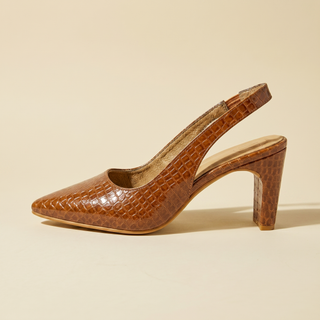
Wear: black tailored trousers that just skim the top of the shoe, a silk shirt, a longline blazer, and Cognac Lustre.
Why it works: the 3 inch block heel gives you the height a function asks for without making the walk to the venue a problem, and warm cognac reads as dressed without looking like you changed for the night. At $199, it is a heel you buy for one work event and keep wearing on ordinary days, which is the real answer to heels that do not break the bank.
Avoid: wearing a brand new pair for the first time on the night. Give them three or four short wears at home first.

2. A spring race day or garden wedding on grass
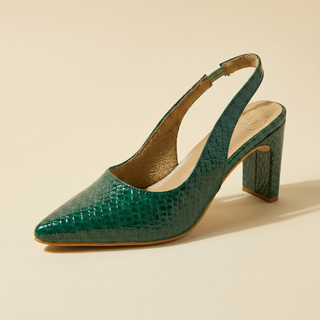
Wear: a satin or crepe midi dress, a structured bag, and Emerald Lustre.
Why it works: a block heel stays on top of a lawn where a stiletto sinks with every step, which matters from October to November when race days and garden weddings are mostly spent standing on grass. The slingback strap keeps the shoe on your foot on uneven ground. Emerald against a neutral or blush dress brings the colour a race day asks for.
Avoid: a strap adjusted for the morning. If the day is warm, check the strap after lunch; it should still let a finger slide under it.
3. A conference day that ends at the dinner
Wear: black trousers, a fine knit, a simple blazer, and The Fiera Mary Jane heel.
Why it works: the strap across the instep holds your foot back in the heel, so standing through sessions does not push your toes into the front of the shoe. The memory foam insole takes the load under the ball of the foot. Leopard with black is a neutral in practice, and it gives people something to remember you by.
Avoid: standing still with your weight locked on both heels. Shift your weight and walk the room between sessions; your feet ache far sooner when they never move.

Six mistakes that make heels hurt by lunchtime
- Trying them on in the morning. Feet swell through the day, more so in summer heat. A pair that fits at 9am can pinch at 4pm. Try on and test in the afternoon.
- Sizing up to fix a tight toe. The extra length lets your foot slide forward and your heel slip out. Look for a better shaped toe instead of a bigger size.
- Ignoring the size note. Some styles run small. Both Lustre heels do, so order one size up; every other Walkie Walkie style is true to size.
- Choosing height before base. A lower stiletto still loads your forefoot more than a slightly taller block. Pick the shape first, then the height.
- Strapping in too tight. A slingback or ankle strap should hold, not grip. If it leaves a mark after an hour, loosen it by one hole.
- Wearing heels for the walk as well as the day. Footpaths, cobbles and car park ramps are harder on shoes and feet than office carpet. Change for the long walk.
The all day heel checklist
Run through these before you commit to a pair, or before a long day in one you already own.
- Is the heel a block or column, not a point?
- Is it 5cm to 7.5cm, or can you honestly stand in it for an hour at home?
- Is there a strap, slingback or instep fastening holding your heel in?
- Is there about 1cm of room past your longest toe, checked in the afternoon?
- Does the insole give when you press it?
- Does the sole bend at the ball of the foot and stay firm under the arch?
- Have you worn them at home for at least three short stretches?
Frequently asked questions
Can heels really be comfortable for a full day?
Yes. A heel with a block base, a height around 5cm to 7cm, a memory foam insole and a secure slingback or strap can be worn comfortably from morning to evening. The discomfort people blame on heels usually comes from a thin sole, a stiletto base, or a loose fit, not from the heel itself. The rest is habit: try them on in the afternoon, break them in at home, and change into flats for a long walk on footpaths.
What is the most comfortable heel height?
Between 5cm and 7cm, or about two to three inches. It gives you the lift and lengthening of a heel while keeping your foot at an angle you can hold for hours. Pair that height with a wide block base for the steadiest, most wearable result. If you want one pair for everything from work to weddings, lean to the top of the range, around 7cm, where the heel still carries a full length trouser.
Are slingback heels comfortable?
Slingbacks are one of the most comfortable heel styles because the strap holds your heel in place and stops your foot sliding forward. That keeps the pressure off your toes and makes the shoe feel secure with every step. The strap should sit on the curve of your heel, not below it, and you should be able to slide a finger under it. If it keeps sliding down, the shoe is slightly too big or the strap needs one hole tighter.
How should comfortable heels fit?
Snug at the heel, with a little room at the toes and no pinching across the widest part of your foot. If your foot slides forward or your heel lifts out as you walk, the fit is off. In numbers, that means about 1cm of space past your longest toe and a heel lift of no more than a few millimetres as you walk. Buying from a brand that offers easy size exchanges takes the guesswork out of getting it right.
How do I break in new heels?
Wear them around the house for short stretches over a few days before a long outing. This lets the lining soften and your foot adjust gradually, so the first full day out is a pleasure rather than a test. Start with 20 to 30 minutes, then an hour, then a morning. Wear them on a clean floor with the socks or hosiery you plan to wear on the day, and notice where you feel pressure early.
Which brands offer comfortable high heels for all day wear?
Look past the brand name to what the product page tells you. A heel built for all day wear lists its heel shape and height, its insole, how it fastens and whether it runs small or true to size. Then check the returns page: free size exchanges matter, because fit is most of comfort. Our Lustre heels are 3 inch block heel slingbacks with a memory foam insole, and size exchanges within 30 days of delivery are free.
Comfortable heels, designed in Australia
This is the thinking behind the Walkie Walkie Lustre heels. Each one is a block heel slingback, designed in Australia, with a memory foam insole and a soft lining built in from the first wear. The five features above are not a wish list. We built them into a shoe you actually want to wear.
Both Lustre styles run small, so order one size up. Sizes run from UK 4 to UK 9. If you prefer a strap across the instep, The Duchess and The Fiera are our Mary Jane heels, each with a memory foam insole and a soft fabric lining, and both are true to size.

A three inch block heel slingback in warm cognac, with a memory foam insole that carries you from the office to dinner without a change of outfit.

The same memory foam block heel comfort in a deep emerald that lands the whole outfit. Cushioned underfoot, attention everywhere else.
Heels you forget you are wearing
Block heel comfort, designed in Australia, backed by our 30 day Comfort Promise. Wear them properly, and if they are not the most comfortable heels you own, send them back within 30 days for a refund.
Explore Cognac Lustre Slingback →Free size exchanges, always.
Shop the Cognac Lustre and Emerald Lustre block heels, designed in Australia with a memory foam insole.
If you love the hold of a slingback, our guide to how slingback heels should fit covers the strap tension and heel checks that keep them secure all day. And if you are still deciding between heel shapes, our block heels versus stilettos comparison goes deeper into why the wider base wins on comfort. For the work question specifically, read heels versus flats for work and shoes that go from work to dinner, or explore the heels collection.